How POMA uses xLMS to make training a cornerstone of safety, performance and innovation
With xLMS, POMA is centralising its training and strengthening its safety culture at the heart of its international expansion.
For over 90 years, POMA has been transporting millions of passengers around the world thanks to its unique expertise in cable transport.
Safety, the reliability of the ski lifts and the quality of service are at the very heart of its DNA.
To meet these requirements, POMA set up an in-house training centre back in the 1980s, with the aim of ensuring that everyone involved in designing, operating or maintaining the installations could develop their skills. This is now the role of the POMA Academy.
POMA Academy’s mission operates within a demanding regulatory framework: the training enables POMA and its clients to meet the requirements of the Safety Management System (SMS) and to demonstrate the skills of seasonal staff to the STRMTG (Technical Service for Ski Lifts and Guided Transport), the government body responsible for the regulation, inspection and safety of ski lifts and guided transport in France.

UPilot®, a comprehensive ecosystem for training management

Teaching: combining digital technology with hands-on learning (Blended Learning)
POMA Academy has developed a method that enables the effective creation of training plans tailored to each organisation, combining a variety of teaching methods: e-learning, face-to-face training and on-the-job training.
The first stage involves studying, analysing and mapping out the structure of the operations and maintenance company. Each role is thus broken down into specific skills, which are linked to training modules delivered via e-learning, face-to-face sessions and on-the-job mentoring.
The second stage involves assessing the learners. POMA uses two types of tests:
- a recruitment test to help operating companies recruit new staff,
- a placement test to assess the level of existing staff.
The third step involves tailoring the training plan to:
- the results of the assessments,
- specific features relating to the customer’s equipment,
- of its organisation,
- the availability of devices.
This training programme has been designed using innovative training methods, such as a procedure trainer and a 3D simulator. These revolutionary tools enable teams to master operations when the ski lift is out of service. Whether training a novice, refreshing an expert’s skills or simulating a disaster scenario, the simulator provides a practical, immersive and completely safe learning environment.
The fourth stage involves delivering the training and assessing the learners’ progress. This progress is assessed through quizzes or on-the-job observations.
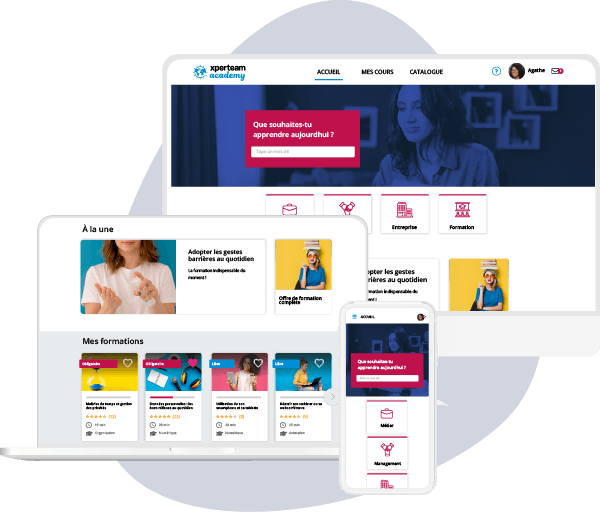
Enabling technology: the xLMS® platform
The xLMS® platform has proved to be an extremely useful tool for:
- Modelling the organisations of clients and their delegate the rights necessary for an autonomous management.
- Assess the learners concerned prior to the training.
- Manage, deliver and track the impact of each training session.
- Validate the findings and identify the discrepancies using visual a9> visual analysis tools such as skills radar charts.

Tangible results to structure training and ensure the safety of operations
With UPilot®, built on xLMS®, POMA Academy has reached a milestone in its ability to deliver training in a a manner that is more consistent, more traceable and more effective, both in France and internationally.
The results can be seen at several levels:
- Training programmes better tailored to the realities on the ground: thanks to assessments carried out in advance, training plans are designed to suit the learners’ level, the equipment involved and the client’s organisation. This makes each programme more relevant and effective.
- Easier international roll-out: with a system already in use in 10 countries and in 6 languages, POMA can more easily disseminate its training standards and support its projects in a wide variety of contexts, including where local expertise needs to be built up almost from scratch.
- Better preparation for teams before commissioning: by combining e-learning, face-to-face training, mentoring, procedural coaching and 3D simulators, POMA can train the teams in advance of the availability of the facilities, which helps to ensure the safety of the start-up and operational phases.
- Enhanced traceability to support compliance: the centralisation of processes, of assessments and of validations enables POMA to better document the training initiatives carried out and to have evidence that is useful within the context of regulatory requirements, in particular those relating to the QMS.
- Practical support for the Group’s safety culture: beyond the tool itself, the programme delivered by POMA Academy helps to promote common standards, structure the learning process and instil good safety habits in operations and maintenance teams on a long-term basis.
Towards comprehensive skills-based decision-making
POMA is now preparing for the next stage: integrating its entire skills mapping system into xLMS®, which is currently still managed in Excel.
This project will:
- To ensure regulatory compliance, particularly with regard to the GMP or ISO standards.
- To build a more agile and efficient organisation: optimise workload planning and assign the right people to the right tasks.
- Supporting career development and skills enhancement: identifying employees’ strengths and areas for improvement, and offering even more tailored training programmes.
At POMA, training is not just a requirement: it is a driving force behind safety, reliability and sustainable innovation.